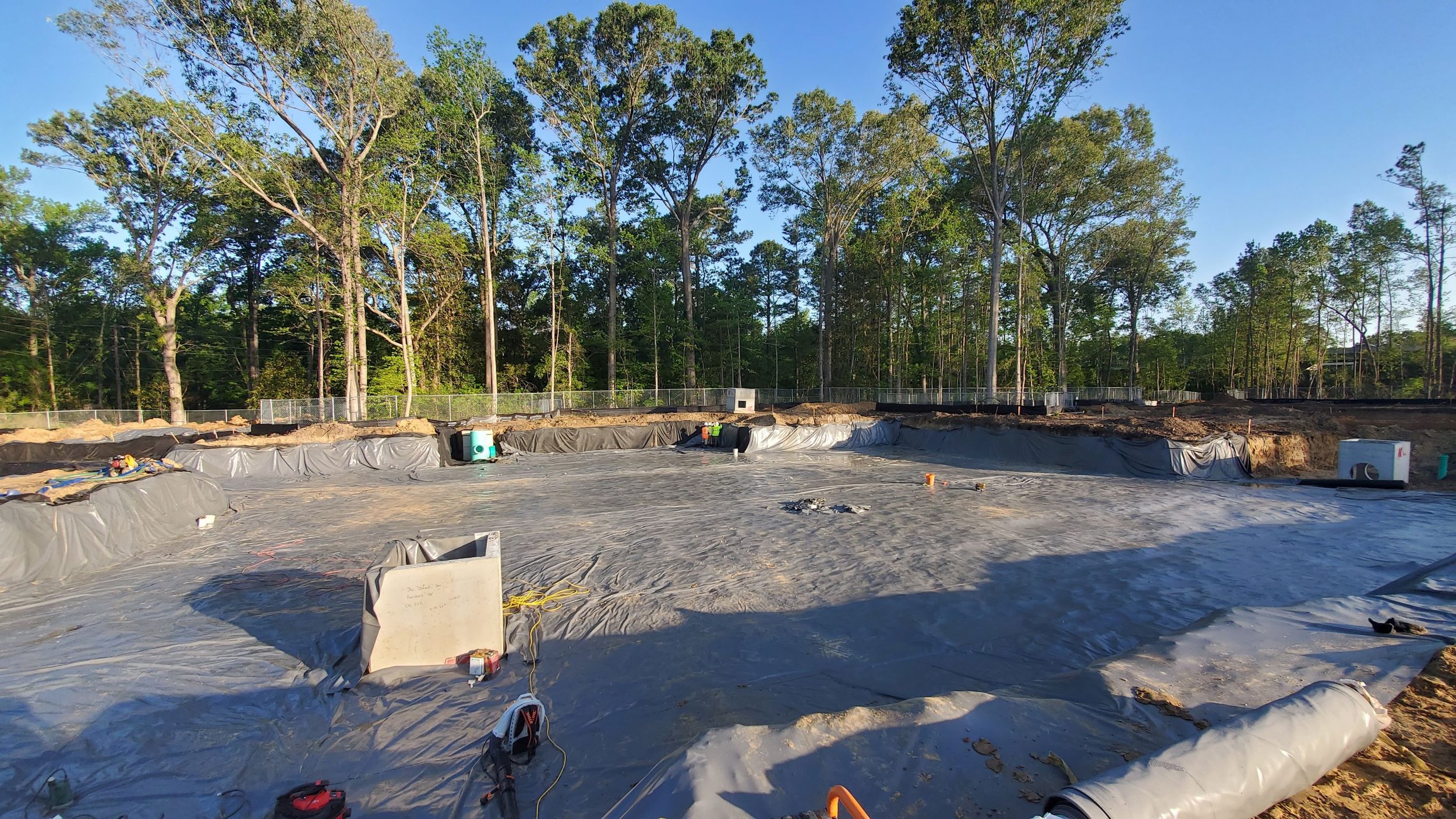
Geomembrane Liner Installation
Geomembrane liners are impermeable membrane materials installed to keep liquids from migrating through soil or containment structures. They show up in water storage, stormwater systems, secondary containment, and landfill work.
Exact Stormwater Management has been installing and repairing geomembrane liner systems throughout the Southeast since 1992. We work with materials including HDPE, LLDPE, PVC, RPP, RPE, XR-5, and related options in thicknesses from about 10 mil to 100 mil.
If you need a liner installed, repaired, or replaced, contact us for a project consultation.
Need a liner installed, repaired, or replaced? Call Exact at (804) 302-5151 for a project consultation.
How liner jobs usually work
On most projects, Exact supplies and installs the liner. The general contractor (or site crew) typically handles fine grading and the anchor trench. Exact places the liner, makes the seams, and boots penetrations (pipes, structures, and other details that go through the liner).
Seaming method depends on the material:
- Chemical welds — common on PVC. Panels are glued with a solvent weld and typically need about a 6-inch overlap.
- Thermal welds — used on polyethylene liners (HDPE / LLDPE and similar). Crews use wedge or extrusion welding to fuse the sheets. For thermal welds, the subgrade must be completely dry — wet or muddy base conditions are a no-go for a reliable seam.
Getting the base right before we mobilize matters as much as the liner itself. We coordinate with your site team so grading, trench, and weather line up with a clean install.
Engineers and GCs: We coordinate liner supply, seaming, and penetration boots with your grading and anchor-trench schedule — contact us early so dry-subgrade and weld method are planned in.
Choosing the right liner material
Material choice depends on what the liner has to hold, UV exposure, flexibility needs, chemical contact, and whether fish or vegetation are part of the design. In plain terms:
- PVC — Common pond and containment liner. Widely used and workable. Not fish-friendly. Not UV-resistant on its own — needs soil cover or enough water depth to keep it protected from sun.
- HDPE — Chemical resistance, many containment and industrial jobs. Strong chemical performance; less flexible than some alternatives.
- LLDPE — Similar polyethylene family when more give is needed. More flexible than HDPE — often chosen when the site needs that flexibility.
- XR-5 — Fuel and secondary containment. Preferred for many fuel / SPCC-style secondary containment applications.
- EPDM — Ponds where fish and long UV exposure matter. Fish-safe and UV-tolerant compared with uncovered PVC.
- Scrim / reinforced panels — Larger factory panels. Factory-built reinforced panels (scrims) for specific designs.
- GCL (bentonite) — Clay-style barrier under cover. Heavy product; cover immediately with soil after placement.
We also install RPP, RPE, and other specified products when the engineer or owner calls for them. Thickness and product are matched to the site — not a one-size-fits-all sheet.
Pond and Lake Liners
Pond and lake liners are among the most common geomembrane applications. They retain water in irrigation ponds, retention ponds, decorative features, golf course hazards, and aquaculture facilities. Without a liner, seepage can make these features impractical to keep full.
Exact installs pond liners for residential, commercial, agricultural, and municipal clients across the Southeast. We commonly install PVC, HDPE, LLDPE, RPP, RPE, XR-5, and EPDM where the application calls for it — selecting material based on water chemistry, UV exposure, fish or wildlife use, and long-term maintenance.
If PVC is on the table for a pond that will see sunlight or fish, we will say so early: uncovered PVC is not UV-stable and is not the fish-friendly choice. Better options exist for those conditions, and we help you pick them before fabrication and mobilization.
Underground Detention and Cisterns
Geomembrane liners are a critical part of many underground detention systems and cisterns. Whether the goal is stormwater harvesting for reuse or keeping groundwater out of the structure, a properly installed liner prevents leakage and supports long-term performance.
Liners are used in modular underground detention systems, concrete cisterns, and precast vaults on residential, commercial, and municipal projects. Exact works with project engineers and contractors to select the liner material and install to the design.
To learn more about lining underground detention and cisterns — including systems such as R-Tank / underground detention — see our R-Tank / underground detention page.
More background on underground detention systems is on our underground detention learning page.
Bioretention, Biofilter, and Dry Swale Liners
Bioretention facilities, biofilters, rain gardens, dry swales, and compost-amended grass swales filter runoff before it reaches streams. Many of these systems need a low-permeability liner at the base to control infiltration, protect groundwater, or meet a permit or engineering specification.
Exact installs geomembrane liners in bioretention and biofilter systems throughout the Southeast. We work as prime contractor on full builds or as a subcontractor for liner-only scope inside a larger project. When a leak is not acceptable, liner detailing and seaming are treated as critical path work — not an afterthought.
For more on how bioretention and rain garden systems are designed and maintained, see our bioretention / rain gardens learning page (liner under the media bed is often part of that conversation).
Secondary Containment Liners
Secondary containment liners support EPA Spill Prevention, Control, and Countermeasure (SPCC) requirements for facilities that store oil or hazardous materials in above-ground storage tanks. The liner creates an impermeable barrier inside berms or dikes so a tank failure or spill does not reach soil, groundwater, or nearby waterways.
Exact installs secondary containment liners for fuel terminals, industrial facilities, and utility sites across the Southeast. We commonly use XR-5 and HDPE for these applications because of chemical resistance and service life. Our crews are experienced working inside active industrial sites and meeting the design and inspection expectations that come with SPCC-regulated containment.
SPCC / fuel containment: Ask about XR-5 and HDPE secondary containment liner installs for active industrial sites.
Geomembrane Liner Repairs and Rehabilitation
All liner systems take stress over time — UV, mechanical loading, chemicals, freeze-thaw. Damage can include punctures, tears, seam failures, and UV degradation. In many cases a targeted repair or partial replacement extends the life of the system without a full rip-out.
Exact performs geomembrane liner repairs and rehabilitation on landfills, lagoons, secondary containment, stormwater basins, and other lined structures. We locate damaged areas, prepare the surface, and patch or weld with methods that match the liner material. When repair is no longer enough, we also replace liners to restore containment.
Repair capability is real — pricing is site-specific. Tell us what you have on the ground (material, size, access, photos if you have them), and we will quote the site. We do not publish day rates on this page.
Geomembrane Liner Projects Across the Southeast
Exact Stormwater Management provides geomembrane liner installation, repair, and replacement across the Southeast, including Alabama, Florida, Georgia, Indiana, Louisiana, Maryland, Mississippi, North Carolina, South Carolina, Tennessee, Texas, and Virginia.
Whether the job is a new install or repair on an existing system, our team brings field experience and material knowledge to deliver a clean result.
Southeast coverage: From Virginia across the Southeast — tell us where the site is and we will confirm crew availability.
FAQ
What liner materials does Exact install?
HDPE, LLDPE, PVC, RPP, RPE, XR-5, and related products in roughly 10–100 mil thicknesses, plus EPDM and GCL when the project calls for them. Material is matched to the application — not sold as a single default sheet.
Do you supply the liner or only install?
Usually both. Exact typically supplies and installs. Site grading and the anchor trench are usually the contractor’s responsibility; Exact places liner, seams, and penetration boots.
What’s the difference between a chemical weld and a thermal weld?
PVC is often joined with a chemical (solvent) weld and about a 6-inch overlap. Polyethylene liners (HDPE / LLDPE) are usually joined with thermal wedge or extrusion welds. Thermal welding needs a completely dry subgrade.
Is PVC OK for a fish pond?
Generally no. PVC is common and workable, but it is not fish-friendly and is not UV-resistant unless covered by soil or deep water. For fish and long sun exposure, materials like EPDM are typically the better conversation.
When do you use XR-5?
Often for fuel and secondary containment work where chemical resistance and durability matter, including many SPCC-style applications.
Can you repair an existing liner?
Yes. We repair and rehabilitate liners when a patch or partial replacement makes sense, and we replace when it does not. Ask for a site-specific quote — we do not publish day rates.
Where do you work?
Across the Southeast (and listed states on the page), from Midlothian, VA and project sites throughout the region.
How do I get started?
Call (804) 302-5151 or email info@exactstorm.com with site location, liner material if known, approximate size, and photos if you have them.
Have plans or photos? Send them to info@exactstorm.com and we will review material, seaming method, and site readiness with you.
Exact Stormwater Management · 13817 Village Mill Drive, Suite D, Midlothian, VA 23114 · (804) 302-5151 · info@exactstorm.com